

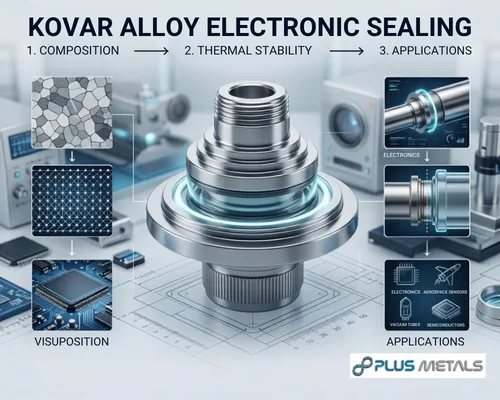
Kovar is an iron-nickel-cobalt alloy engineered to provide a controlled coefficient of thermal expansion (CTE) that closely matches that of borosilicate glass and many technical ceramics, enabling durable glass-to-metal and ceramic-to-metal seals. The typical composition centers on roughly 29% nickel, about 17% cobalt and the balance iron, with tight manufacturing tolerances to ensure repeatable thermal expansion characteristics. This precise alloy chemistry yields stable mechanical strength across a wide temperature range and allows formation of a thin, adherent oxide layer that is essential for hermetic sealing processes.
Kovar Alloy Benefits
- Matched thermal expansion: Kovar’s main advantage is its CTE match to common glass and ceramic sealing materials, which minimizes stress during thermal cycling and prevents cracking or seal failure
- Hermetic reliability: The alloy forms a controlled surface oxide after conditioning that promotes wetting and bonding with glass and ceramic, producing long-term hermetic seals
- Thermal shock resistance: Because of its balanced mechanical properties and stable CTE, components made from Kovar withstand rapid temperature changes better than many alternative alloys
- Machinability and fabrication: Kovar can be machined, stamped, and formed with standard techniques used for ferrous alloys, then thermally processed for sealing without compromising dimensional stability
- Compatibility with brazing and welding: Kovar responds well to common joining methods used in electronic packaging, providing versatile assembly options for complex devices
Electronic Sealing Applications
- Glass-to-metal seals for vacuum tubes, sensors, and photomultiplier assemblies where hermeticity is critical
- Lead frames, feedthroughs, and pins for hermetic packages used in aerospace, medical implants, and high-reliability industrial electronics
- Ceramic-to-metal seals in microwave devices, high-frequency packages, and resonant components where controlled expansion is essential
- Enclosures for sensors and optical assemblies where long service life and resistance to environmental ingress are required
- Specialized packages for high-temperature or cycling environments in defence and aerospace applications that demand precision material matching
Material Conditioning and Sealing Process Notes
For reliable electronic sealing, Kovar parts typically undergo a thermal conditioning sequence: decarburization or degassing in a reducing atmosphere to remove surface contamination, followed by controlled oxidation to form the thin, adherent oxide layer that bonds to glass or ceramic during sealing. Process parameters (temperature, atmosphere composition, hold time) are tuned to the specific glass/ceramic used and the end-item requirements. Correct preconditioning markedly improves seal yield and long-term hermetic performance.
Why Choose Plus Metals for Kovar and Expansion Alloys
Plus Metals stocks and supplies high-performance expansion alloys with consistent chemistry and traceable mill test documentation suitable for hermetic electronic packaging and critical industrial uses. With expertise in specialty alloys, precision cutting, and technical support, Plus Metals can assist with material selection, recommended conditioning cycles, and supply logistics to meet qualifying and production needs. To understand how expansion alloys compare, also review our Expansion Alloy 42 vs Expansion Alloy 49 guide.
Illustrative Example
A sensor manufacturer designing a borosilicate-sealed feedthrough requires a frame material that expands similarly to the glass over -55°C to +125°C cycling. Choosing Kovar for the feedthrough minimizes differential strain during seal cooling and service temperature swings; with correct decarburization/oxidation conditioning, the feedthrough achieves hermeticity required for long-term field reliability.
Technical Considerations When Specifying Kovar
- Specify the required CTE tolerance and match it to the specific glass/ceramic being used
- Provide required mechanical properties, plating needs (if any), and post-machining heat treatments
- Identify whether brazing, welding, or direct sealing will be used so surface preparation can be planned accordingly
- Request material certification and dimensional inspection as part of the procurement package
Contact Plus Metals for Kovar and Expansion Alloys
For Expansion Kovar Alloy and other controlled expansion alloys requirements globally, partner with Plus Metals—the trusted source for high-performance materials:
Email: sales@plusmetals.in
Call / WhatsApp: +91 91673 47029
Website: www.plusmetals.in
Message them today to discuss your requirements. They understand international standards and project timelines, delivering trust, quality, and long-term performance.
Frequently Asked Questions (FAQs)
Q1: What is Expansion Kovar Alloy used for?
Expansion Kovar Alloy is primarily used to make glass-to-metal and ceramic-to-metal hermetic seals in electronic packaging.
Q2: What is the standard Kovar alloy composition?
Kovar typically contains about 29% nickel, 17% cobalt and the remainder iron, produced to narrow tolerances for controlled CTE.
Q3: How does Kovar help with electronic sealing?
Kovar’s controlled thermal expansion and surface oxide chemistry enable strong, leak-tight bonds with glass and ceramic seals.
Q4: Can Kovar be soldered or brazed?
Yes — Kovar is compatible with typical brazing and soldering processes after appropriate surface conditioning.
Q5: Is Kovar suitable for aerospace electronics?
Yes — Kovar is commonly used where hermeticity and thermal cycling resistance are critical in aerospace and defence electronics.