

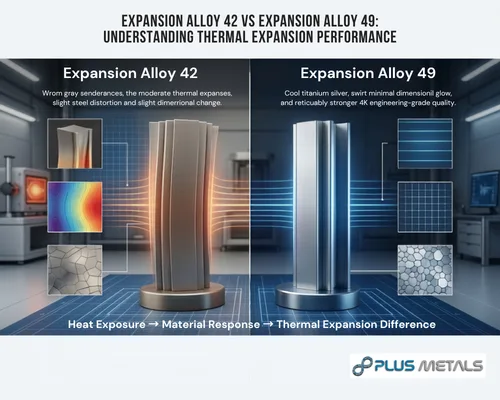
When applications demand dimensional stability, even small changes in temperature can affect performance, fit, and reliability. That is why choosing the right Thermal Expansion Alloys matters, especially when comparing Expansion Alloy 42 vs Expansion Alloy 49 for precision assemblies, electronics, and engineered components.
Plus Metals, based in Mumbai, India, is a supplier of special purpose metals and alloys, including high-performance materials such as expansion alloys, nickel-based alloys, and titanium alloys. The company supports industrial users with stock supply, precision cutting, deburring, and distribution services.
What Is Expansion Alloy 42?
Expansion Alloy 42 is a nickel-iron alloy valued for its controlled and relatively low thermal expansion rate. It is widely used where stable dimensions are important, especially in parts that must remain accurate through temperature changes.
In practical terms, Expansion Alloy 42 is often chosen for applications that need a balance of machinability, strength, and thermal stability. This makes it useful in electronic components, glass-to-metal seals, and precision parts where performance consistency matters.
What Is Expansion Alloy 49?
Expansion Alloy 49 is also part of the family of low-expansion materials and is selected for applications that need precise thermal behavior. Like other Thermal Expansion Alloys, it helps reduce movement caused by temperature variation and supports long-term dimensional control.
For engineers and buyers, Expansion Alloy 49 is often considered when the application requires a very specific thermal response and dependable performance under repeated heating and cooling cycles. In a Low Thermal Expansion Alloy Comparison, this makes it an important material to evaluate alongside Expansion Alloy 42.
Expansion Alloy 42 vs Expansion Alloy 49
The key difference in Expansion Alloy 42 vs Expansion Alloy 49 is how each alloy performs under heat in relation to the requirements of the final application. Both are used for thermal stability, but the right choice depends on the exact coefficient of thermal expansion, fabrication needs, and component design.
In many industrial cases, Expansion Alloy 42 is selected for general low-expansion performance, while Expansion Alloy 49 is considered where a different thermal profile is needed for tighter design control. A careful Low Thermal Expansion Alloy Comparison helps engineers choose the material that best matches dimensional tolerance, reliability, and production goals.
Comparison Snapshot
| Property | Expansion Alloy 42 | Expansion Alloy 49 |
|---|---|---|
| Thermal behavior | Low expansion, stable performance | Low expansion, specific controlled performance |
| Typical use | Precision parts, electronics, seals | Precision assemblies, controlled thermal applications |
| Selection focus | Balance of stability and fabrication | Exact thermal response and fit |
| Best for | General thermal control needs | More application-specific thermal requirements |
Why Thermal Expansion Matters
Thermal expansion affects how a component fits, seals, and performs when temperatures change. In assemblies made from dissimilar materials, even a small mismatch can create stress, looseness, leakage, or failure over time.
That is why industries prefer Thermal Expansion Alloys for high-accuracy manufacturing. The right alloy improves service life, protects performance, and supports cleaner assembly outcomes in demanding environments. To learn more about related low-expansion materials, read our analysis on Expansion Alloy 49 vs Conventional Expansion Alloys.
Why Choose Plus Metals
Plus Metals presents itself as a specialty metals and alloys supplier serving aerospace, defense, industrial, and precision engineering needs from Mumbai. The company highlights a broad material range, including expansion alloys, nickel-based alloys, and other high-performance metals.
For customers looking for dependable sourcing, Plus Metals also emphasizes service support such as precision cutting and distribution. This makes it a practical supply partner for buyers who need material quality and delivery support in one place.
Contact Plus Metals for Expansion Alloys
For Expansion Alloy 42, Expansion Alloy 49, and other controlled expansion alloys requirements globally, partner with Plus Metals—the trusted source for high-performance materials:
Email: sales@plusmetals.in
Call / WhatsApp: +91 91673 47029
Website: www.plusmetals.in
Message them today to discuss your requirements. They understand international standards and project timelines, delivering trust, quality, and long-term performance.
Frequently Asked Questions (FAQs)
Q1: What is the main difference between Expansion Alloy 42 vs Expansion Alloy 49?
The main difference lies in their thermal expansion behavior and application fit. Both are low-expansion alloys, but the right choice depends on the exact temperature stability required.
Q2: Where are Expansion Alloy 42 and Expansion Alloy 49 used?
They are used in precision engineering, electronics, seals, and assemblies that must stay dimensionally stable during temperature changes. These materials help reduce thermal stress and distortion.
Q3: Are Expansion Alloy 42 and Expansion Alloy 49 considered Thermal Expansion Alloys?
Yes, both belong to the category of Thermal Expansion Alloys designed to control dimensional changes caused by heat. This is why they are popular in high-precision applications.
Q4: Which alloy is better for a Low Thermal Expansion Alloy Comparison?
There is no single best option for every use case. A Low Thermal Expansion Alloy Comparison should consider thermal behavior, fabrication needs, and the component’s operating temperature range.
Q5: Does Plus Metals supply expansion alloys in India?
Yes, Plus Metals is a Mumbai-based supplier of specialty metals and alloys, including expansion alloys, with support for stock supply and related services.