

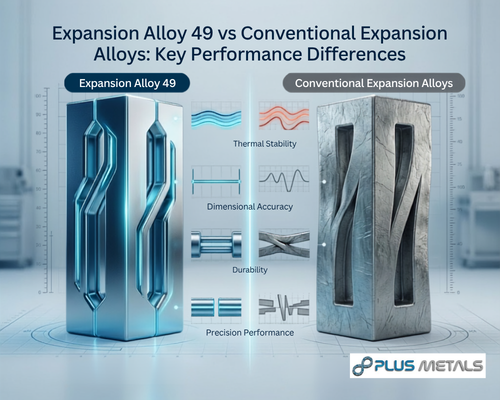
In the world of high-performance metal supply, precision materials that maintain dimensional stability under temperature variations are essential for advanced engineering applications. Expansion Alloy 49 (also known as Invar 49 or UNS K94890) represents a specialized category of controlled expansion alloys that outperforms conventional expansion materials in critical performance metrics. This comprehensive analysis examines how Expansion Alloy 49 vs conventional expansion alloys differ and why industries worldwide choose this premium nickel-iron alloy for precision applications.
Plus Metals, a leading high-performance metal supplier headquartered in Mumbai, India, has established itself as a trusted global provider of expansion alloys, nickel-based alloys, high-temperature alloys, and titanium alloys. With over two decades of service experience and state-of-the-art facilities, Plus Metals delivers mill-certified materials with full traceability to Fortune 500 companies, research institutions, and engineering firms worldwide.
For a deeper understanding of how expansion alloys compare, read our analysis on Why Expansion Alloy 36 Is Preferred for Precision Engineering Applications.
Understanding Expansion Alloy 49
Expansion Alloy 49 is a nickel-iron alloy characterized by approximately 49% nickel content with the remainder being iron. This precise composition results in an exceptionally low coefficient of thermal expansion (CTE) of approximately 1.2 × 10⁻⁶/°C (1.2 ppm/°C), making it ideal for environments requiring precise dimensional stability despite temperature fluctuations.
The alloy's designations include NILO 49, DIN 1.3912, and A49, indicating adherence to international standards. Unlike conventional metals that expand significantly with temperature, Alloy 49 exhibits minimal thermal distortion, maintaining exact measurements across varying thermal conditions.
Expansion Alloy 49 vs Conventional Expansion Alloys: Performance Comparison
Thermal Expansion Properties
The most significant difference between Expansion Alloy 49 and conventional expansion alloys lies in their thermal expansion coefficients:
| Material | CTE (ppm/°C) | CTE (ppm/°F) |
|---|---|---|
| Expansion Alloy 49 | 1.2 | 2.9 |
| Conventional Steel | 11–15 | 6.0–8.3 |
| Aluminum Alloy | 21–24 | 11.6–13.3 |
| Invar 36 | 1.2–1.6 | 2.9–3.0 |
| Alloy 48 | 1.2 | 2.9 |
Expansion Alloy 49's CTE is approximately 10 times lower than conventional steel and nearly 20 times lower than aluminum alloys. This dramatic difference makes Alloy 49 the superior choice for precision applications where thermal distortion must be minimized.
Controlled Expansion Alloy vs Standard Alloy: Key Differences
Controlled expansion alloys like Alloy 49 are specially formulated metallic compounds engineered to expand uniformly or minimally with temperature changes. In contrast, standard alloys exhibit significant and often unpredictable expansion rates.
Key performance distinctions include:
- Dimensional Stability: Alloy 49 maintains tight tolerances under temperature swings, while conventional alloys experience measurable dimensional changes
- Predictability: Controlled expansion alloys exhibit predictable, uniform expansion patterns versus the variable expansion of standard materials
- Glass-to-Metal Compatibility: Alloy 49's CTE matches soft lead and soda-lime glasses, enabling hermetic seals without cracking
- Magnetic Permeability: Alloy 49 possesses high magnetic permeability advantageous for instrument transformers and magnetic shielding applications
Expansion Alloy 49 Thermal Expansion Properties
The thermal expansion characteristics of Alloy 49 make it uniquely suited for precision engineering:
- Coefficient of Thermal Expansion: 1.2 × 10⁻⁶/°C (measured between 20°C–100°C)
- Density: 8.2 g/cm³, balancing strength and weight
- Thermal Conductivity: 14–16 W/m·K, providing moderate heat conductivity while ensuring dimensional stability
- Temperature Range: Maintains low expansion properties up to 450°C
These properties position Alloy 49 slightly higher than Alloy 48 in expansion rate, yet both remain highly suitable for precision applications requiring minimal thermal distortion.
Low Expansion Alloy 49 Applications
Expansion Alloy 49 serves critical applications across multiple industries where dimensional stability is paramount:
Electronics & Telecommunications
- Glass sealing for fiber optics
- Integrated-circuit lead frames
- Optical fiber systems and microwave components
- Hermetic seals for integrated circuits
Aerospace & Defense
- Satellite components maintaining alignment despite temperature swings
- Optical sensors requiring calibration integrity
- Aerospace engineering composite molds
- Structural components in optical and laser measuring systems
Precision Instruments
- Research equipment requiring exact measurements across varying temperatures
- Telescopes and microscopes preventing temperature-induced distortion
- Laser modules and metrology equipment
- Precision mechanical assemblies
Medical & Energy
- Laser and X-ray machine components
- LNG storage and transportation vessels
- Superconducting systems in power transmissions
- High-precision surgical instruments
Automotive
- Sensors and precision engine components
- Springs, connectors, and precision instruments
Plus Metals: Global High-Performance Metal Supply
Plus Metals stands as a premier supplier of Expansion Alloy 49 and other high-performance materials globally. The company's expertise spans:
- Comprehensive Inventory: Mill-certified limited expansion alloys, nickel-base alloys, high-temp alloys, and titanium alloys in various diameters, gauges, lengths, and tempers
- Product Forms: Expansion Alloy 49 available as rods, bars, wires, sheets, plates, strips, coils, tubes, and custom fabrications
- Quality Assurance: ISO-certified exporter with dedication to precision across all operations including cutting, deburring, and distribution
- Global Reach: International export capabilities with facilities serving customers worldwide, including locations in California, New Jersey, and Mumbai
- Rapid Delivery: 24-hour dispatch for stock items with mill certifications included
With over two decades of service experience, Plus Metals supports supply chain requirements for individuals, researchers, universities, and manufacturers worldwide while maintaining fundamental principles of customer satisfaction, integrity, and material quality.
Explore our full range of expansion alloy solutions for your precision engineering needs.
Expansion Alloy 49 Performance Comparison Summary
| Performance Metric | Alloy 49 | Conventional Alloys | Advantage |
|---|---|---|---|
| Thermal Expansion | 1.2 ppm/°C | 11–24 ppm/°C | 10–20× lower |
| Dimensional Stability | Excellent | Variable | Superior |
| Glass Sealing Compatibility | Yes | Limited | Full compatibility |
| Magnetic Permeability | High | Variable | Enhanced performance |
| Temperature Range | Up to 450°C | Variable | Extended range |
Contact Plus Metals for Expansion Alloy 49
For Expansion Alloy 49 and other controlled expansion alloys requirements globally, partner with Plus Metals—the trusted source for high-performance materials:
Email: sales@plusmetals.in
Call / WhatsApp: +91 91673 47029
Website: www.plusmetals.in
Message them today to discuss your requirements. They understand international standards and project timelines, delivering trust, quality, and long-term performance.
Frequently Asked Questions (FAQs)
Q1: What makes Expansion Alloy 49 different from conventional expansion alloys?
Expansion Alloy 49 has a coefficient of thermal expansion of approximately 1.2 × 10⁻⁶/°C, which is 10 times lower than conventional steel (11–15 ppm/°C). This exceptional low expansion maintains dimensional stability across temperature variations, making it superior for precision applications.
Q2: What are the primary applications of Low Expansion Alloy 49?
Alloy 49 is used in fiber optics glass sealing, satellite components, integrated-circuit lead frames, research equipment, optical devices, LNG storage systems, and precision instruments requiring exact measurements across varying temperatures.
Q3: How does Expansion Alloy 49 compare to Alloy 48?
Alloy 49's expansion rate is slightly higher than Alloy 48, but both exhibit very low thermal expansion (approximately 1.2 × 10⁻⁶/°C). Both are highly suitable for precision applications, with Alloy 49 offering high magnetic permeability for transformer cores and magnetic shielding.
Q4: What is the difference between a controlled expansion alloy and a standard alloy?
Controlled expansion alloys are engineered to expand uniformly or minimally with temperature, exhibiting predictable expansion patterns. Standard alloys expand significantly and often unpredictably. Controlled expansion alloys like Alloy 49 provide superior dimensional stability for precision applications.
Q5: Why choose Plus Metals for Expansion Alloy 49 supply?
Plus Metals offers mill-certified Expansion Alloy 49 in multiple forms (rods, bars, wires, sheets, plates) with full traceability, ISO certification, international export capabilities, and 24-hour dispatch for stock items. With over 20 years of experience, they serve Fortune 500 companies and research institutions worldwide.