

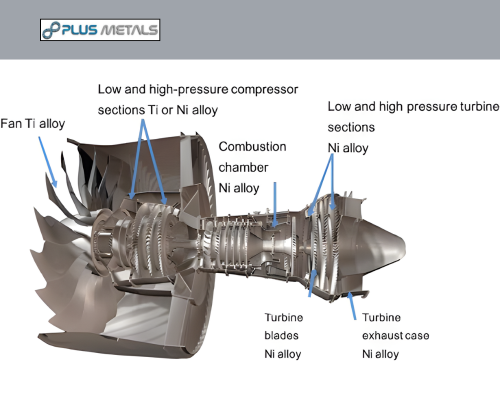
Two grades can both be described as "high temperature nickel alloys", both will pass a chemistry check, and one can be entirely wrong for the component you are building. This page sets the main candidates side by side — composition, strengthening mechanism, governing specification, service limits — so the comparison happens on properties rather than on marketing language, and ends with what to check on the certificate when the material arrives.
The Head-to-Head Comparison
| Alloy | UNS / EN | Base | Strengthening | Density (g/cm³) | Oxidation limit |
|---|---|---|---|---|---|
| Inconel 718 | N07718 / 2.4668 | Nickel-iron-chromium | Gamma double-prime (Ni3Nb) | 8.19 annealed, 8.22 aged | ~982 °C |
| Waspaloy | N07001 / 2.4654 | Nickel with 12–15% cobalt | Gamma-prime (Ni3(Al,Ti)) | 8.19 | Corrosion-oriented; service limit is stress-dependent |
| Haynes 188 | R30188 | Cobalt-nickel-chromium | Solid solution | 8.98 | ~1095 °C |
| Haynes 230 | N06230 | Cobalt-nickel-chromium-tungsten | Solid solution | 8.97 | ~1149 °C |
| Haynes 242 | Age-hardenable | Nickel-chromium-cobalt-molybdenum | Age hardening | ~8.4 | Moderate; strength-oriented rather than oxidation-oriented |
| Nimonic 75 | N06075 | Nickel-chromium | Gamma-prime | ~8.37 | ~950–1000 °C |
| Nimonic C263 | Age-hardenable | Nickel-chromium-cobalt-molybdenum | Gamma-prime + age hardening | ~8.36 | Moderate |
Read the density column as well as the temperature column. Moving from a nickel alloy to a cobalt-based one costs about 0.8 g/cm³, roughly 9% more mass per unit volume. For a turbine component where weight matters, that is a real penalty, and it is the reason cobalt-based grades are used in the hottest stations and in fixtures rather than across the board.
The oxidation limits are also not directly comparable to service temperature. An alloy that resists oxidation to 1095 °C does not carry structural load at 1095 °C — the application guide covers this distinction in detail.
Strengthening Mechanism: The Deciding Difference
Three mechanisms appear in the table above, and they explain nearly every practical difference between the grades.
- Solid solution (Haynes 188, Haynes 230) — solute atoms distort the lattice and impede dislocation movement. Strength is modest but stable, and crucially the properties do not degrade with time at temperature in the way aged alloys can. This family is chosen for oxidation and hot corrosion resistance, not for strength.
- Gamma prime (Waspaloy, Nimonic grades) — Ni3(Al,Ti) precipitate particles remain stable and closely spaced, giving excellent creep resistance at high temperature. The trade-off is that these alloys can suffer strain-age cracking under sustained load, and this is the single most important practical constraint when specifying them.
- Gamma double prime (718) — a related but distinct metastable phase that forms more slowly than gamma prime. The slow formation is what gives 718 its exceptional weldability: the weld can be made and then stress-relieved without the precipitate prematurely locking in. It is why 718 dominates welded high temperature fabrication.
The practical consequence: 718 and Waspaloy are not interchangeable substitutes for each other. Waspaloy outperforms 718 above roughly 650–705 °C, but it brings strain-age cracking susceptibility with it. Dropping Waspaloy into an 718 position or vice versa can introduce a failure mode the original design never had to consider.
Specifications by Product Form
The most common ordering error on these grades is a form and specification mismatch. The standard is determined by the product form, not by preference.
| Grade | Product form | Typical specification |
|---|---|---|
| Inconel 718 | Bar, rod, forging stock | ASTM B637 / SB637; AMS 5662 (solution treated), AMS 5663 (aged) |
| Plate, sheet, strip | AMS 5596, AMS 5597 | |
| Forgings | AMS 5666, AMS 5667 | |
| Waspaloy | Bar, rod, forging stock | ASTM B637; AMS 5708, AMS 5709 |
| Haynes 188 | Plate, sheet | AMS 5608 |
| Bar, rod, forging stock | AMS 5772; wire to AMS 5801 | |
| Haynes 230 | Plate, sheet, bar | AMS 5544 for plate and sheet |
Note how many specifications exist per grade, and that AMS 5662 and AMS 5663 describe different heat treatment conditions of the same alloy. "718 bar" is not a complete order — you need the condition. Solution-treated and aged 718 have different strength, different grain structure and different certificates, and an order that omits the condition is ambiguous in a way that will surface at inspection.
Heat Treatment Conditions
- Solution treated — heated above the solvus and cooled rapidly. Dissolves the precipitates, producing a workable, corrosion-resistant condition that will age in service. This is what AMS 5662 specifies for 718.
- Aged (precipitation hardened) — solution treatment followed by controlled ageing to grow the precipitates to their optimum size. Maximum strength, and what AMS 5663 specifies for 718.
- Double aged — a two-step ageing cycle used on some alloys to refine the precipitate distribution and improve stability.
- Annealed / as-melted condition — supplied for customer solution treatment and ageing, used where the component will be heat treated after forming.
Choosing Between 718 and Waspaloy
This is the decision that comes up most often, so it is worth stating plainly.
| Consideration | Inconel 718 | Waspaloy |
|---|---|---|
| Relative strength | Higher below ~650 °C | Higher above ~650–705 °C |
| Weldability | Excellent — the standout property, due to slow gamma-double-prime formation | Good, but requires more control; strain-age cracking must be considered |
| Post-fabrication stress relief | Readily stress-relieved after welding | Constrained by strain-age cracking risk |
| Strain-age cracking | Not characteristic | Susceptible — the governing constraint |
| Cryogenic use | Good — usable to around −200 °C in solution-treated condition | Not the intended service range |
| Typical applications | Turbine discs and casings, fasteners, springs, heat treatment fixtures, welded structures, nuclear internals | Hot section fasteners, highly stressed rotating and static parts at elevated temperature |
Two further points that are easy to miss. First, service temperature limits for Waspaloy depend on applied stress — a lightly loaded part can be rated considerably higher than a heavily loaded one on the same geometry. Second, for oxidising service 718 is often cited to about 982 °C, but that figure relates to oxidation behaviour, not to load-carrying capability; the usable structural limit is far lower.
Quality Assurance and Inspection
For high temperature applications the certificate is not paperwork to be filed away — it is the evidence that the material in the component was processed correctly. These are the checks that matter.
- Chemical composition by spectrometry — reported against the element ranges of the named specification. For the gamma-prime grades the ranges on nickel, chromium, cobalt, molybdenum, titanium and aluminium are tightly controlled because precipitate formation depends on them.
- Mechanical properties — tensile strength, yield strength and elongation in the delivered condition, on the specified specimen orientation. Note that the specified form changes the specimen and therefore the numbers.
- Heat treatment verification — the delivered condition must match the specification. This is checked by hardness testing, by microstructure examination, or by electrical conductivity measurement, which responds to precipitate formation and is a reliable and rapid confirmation that ageing occurred as specified.
- Grain size — controlled for fatigue performance. Fine grain improves ductility and toughness, coarse grain improves creep resistance. An off-spec grain size that passes chemistry and tensile tests can still fail a fatigue requirement.
- Dimensional inspection and surface condition — for bar, diameter and straightness; for plate and sheet, thickness, flatness and surface defect limits.
- Dye-penetrant or ultrasonic flaw detection — quoted where the component is safety-critical or where surface-connected defects are a concern.
- Positive material identification (PMI) — alloy verification on the finished part. Important in fabrication shops handling many similar-looking grades, and it is how mixed-grades get caught before machining.
Traceability is the thread that ties these together. Every certificate should carry the heat or lot number, and that number must follow the material through fabrication to the finished component. On a grade like 718 that may be solution-treated and then aged by the fabricator, the chain has to cover both operations — an unbroken chain from mill to finished part, or the provenance of the component is not established.
Certification Levels
| Level | What it confirms | Typical requirement |
|---|---|---|
| EN 10204 3.1 | Product conforms to the order, verified by an accredited independent inspector | Standard for aerospace high temperature alloys |
| EN 10204 3.2 | Product conforms to the order, additionally verified by the buyer's inspector or nominated party | Contract, pressure and nuclear work |
| EN 10204 2.2 / 2.1 | Manufacturer declaration based on the works order | Non-critical components |
On these grades, 3.1 is the normal expectation and 3.2 is specified where the contract demands it. Both confirm conformance to the order — the difference is the verifying party, with 3.2 giving the buyer or its nominated party the right to witness. Third-party witnessing by agencies such as SGS, BV, Lloyd's or TÜV can be arranged. Because the certificate confirms conformance to the order, an order that omitted the heat treatment condition cannot be rescued by a technically valid certificate — which is why the condition has to be on the purchase order.
Alloys Available and Where to Read More
- Inconel 718 (Alloy 718) — gamma double-prime, the general-purpose high temperature grade.
- Waspaloy — gamma-prime with cobalt, for the higher-temperature stressed duty.
- Haynes 188 — cobalt-based solid solution for combustors and hot corrosion.
- Haynes 230 — the most severe oxidation environment of the group.
- Haynes 242 — age-hardenable, for intermediate-temperature structural and fastener duty.
- Nimonic 75 and Nimonic C263 — gamma-prime grades for elevated-temperature components.
Supply is issued with an EN 10204 3.1 MTC as standard, reporting chemistry and mechanical results against the specification named on your order, with heat-number traceability. For the full range see high temperature alloys.
Request Specifications and Pricing
Send the alloy and UNS number, product form, condition, dimensions, governing specification and certification requirement, and we will confirm availability and quote against the standard your inspection will be judged against. If you are weighing two grades, tell us the service temperature, applied stress and atmosphere and we will give a direct recommendation with the constraint that governs it.
Enquire Now – Send grade, form, condition and dimensions for a quote
Visit – www.plusmetals.in
Frequently Asked Questions
Q1. Is Inconel 718 better than Waspaloy for high temperature service?
Neither is better — they suit different temperature ranges. 718 has the higher strength below roughly 650 °C, is by far the easier alloy to weld and stress relieve, and is the safer choice for anything fabricated. Waspaloy holds its strength advantage above roughly 650–705 °C and is the correct choice for hot section fasteners and very highly stressed parts in that range, provided the strain-age cracking risk is properly addressed. For structural components that will be welded, choose 718 unless the service temperature rules it out.
Q2. Why is 718 preferred for welding when Waspaloy performs better at temperature?
Because 718 forms its strengthening gamma-double-prime precipitate slowly. That slow formation means the alloy can be welded and then stress relieved without the precipitate prematurely locking in and preventing stress relief — which would leave residual stress in a high temperature component. Waspaloy forms its gamma-prime precipitate more readily, which is exactly what gives it its strength advantage at temperature, and also what constrains post-weld heat treatment. This single metallurgical difference decides the fabricability comparison.
Q3. What do I need on the purchase order for a high temperature bar order?
Six items: the alloy and UNS number; the product form, since the standard and specimen change with it; the condition (solution treated, aged, or as supplied for customer heat treatment) — this is the one most often omitted and it makes the order ambiguous; dimensions and quantity with tolerance; the governing specification (ASTM, AMS, ASME or EN); and the certification level, normally EN 10204 3.1 for aerospace work and 3.2 where the contract requires independent witnessing. Grain size requirements should be added where fatigue performance governs.
Q4. How do I verify that a high temperature alloy was heat treated correctly?
Three practical methods. Hardness testing gives a quick relative confirmation that ageing occurred. Electrical conductivity measurement is the most reliable rapid check, because conductivity changes measurably as precipitates form — it is widely used to verify ageing without destructive testing. Metallographic examination of the precipitate morphology and grain structure confirms both the heat treatment and the grain size, and is the definitive method where the specification calls for it. For 718 specifically, the certificate should state the condition, and the condition should be verified by one of these methods before the component goes into service.
Q5. Can you supply an alloy that is not in your standard range?
Raise it as a specific enquiry. Grades such as Incoloy 800H, Hastelloy X and Inconel 601 are all legitimate high temperature materials and we will confirm what can be sourced against the standard, form and condition you specify. What we will not do is quote an approximate equivalent in place of a grade your design depends on — if a substitution is technically possible, we will tell you what changes about it, including the service limits and the certification that would come with it.