

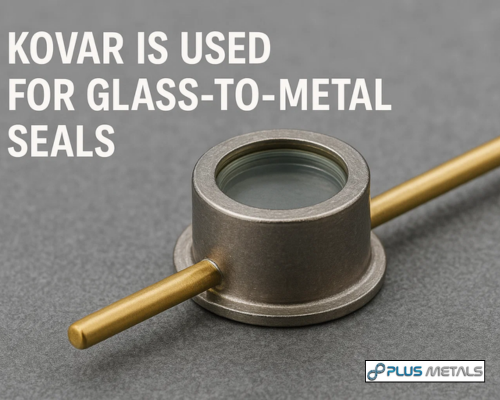
In modern engineering, reliability and material stability matter more than ever. One of the most trusted solutions used across aerospace, electronics, medical devices, and vacuum technologies is the glass-to-metal seal. These seals must survive temperature changes, pressure variations, and long operating hours all without cracking or leaking.
What Is Kovar?
Kovar is a nickel–cobalt–iron alloy specifically engineered to match the thermal expansion rate of glass, especially borosilicate glass. Its typical composition includes:
- ~29% Nickel
- ~17% Cobalt
- Balance Iron, with minor additions of silicon and manganese
This unique combination makes Kovar a controlled-expansion alloy, which is the primary reason why Kovar is used for glass-to-metal seals in critical engineering applications.
Why Thermal Expansion Matching Is Crucial
Glass and metal expand differently when exposed to temperature changes. If the expansion rates don’t match, the seal will eventually:
- Develop micro-cracks
- Loosen
- Lose vacuum integrity
- Fail under thermal cycling
Kovar's thermal expansion closely matches that of hard glasses. This prevents stress build-up at the joint and ensures a stable, long-lasting seal. This property alone explains why Kovar is used for glass-to-metal seals in electronic packaging, aerospace devices, and hermetically sealed components.
Key Advantages of Using Kovar for Glass-to-Metal Seals
1. Superior Thermal Expansion Compatibility
The most important benefit is its ability to expand and contract at the same rate as the glass. This creates a strong mechanical bond without internal stress.
2. Excellent Mechanical Strength
Kovar maintains stability in:
- High-pressure environments
- Vacuum conditions
- High-temperature chambers
- Repeated heating and cooling cycles
This makes it ideal for high-end technology applications.
3. Hermetic, Leak-Proof Sealing
Electronics, aerospace equipment, and scientific instruments require airtight sealing. Kovar forms stronger and more stable bonds compared to standard stainless steels or other nickel alloys.
4. High Temperature & Oxidation Resistance
Kovar can be used in components that experience continuous heat, shock loads, or harsh atmospheres.
5. Perfect for Vacuum Technology & Electronics
This is why Kovar is widely used in:
- Power tubes
- Medical device connectors
- Microwave components
- Telecommunication housings
- Laser systems
- Aerospace sensors
In all these applications, the reliability of glass-to-metal seals is non-negotiable, and Kovar provides precisely that.
Why Buy Kovar from Plus Metals?
Plus Metals is one of India’s trusted suppliers for Kovar alloy in sheets, bars, rods, plates, and customised cut sizes. Industries choose Plus Metals because:
- ✔ 100% genuine, certified Kovar material
- ✔ Mill Test Certificates (MTCs) with every order
- ✔ Custom cutting and size availability
- ✔ Timely delivery across India
- ✔ Competitive prices for bulk orders
- ✔ Trusted by aerospace, defence, electronics & engineering manufacturers
If your company is working with glass-to-metal seals, high-precision components, or hermetically sealed parts, Plus Metals ensures you receive stable and high-performing Kovar every time.
Ready to Order?
Visit: www.plusmetals.in
contact us: +91 91673 47029
This industry trust is another reason manufacturers get reliable material for applications where Kovar is used for glass-to-metal seals — because quality at the material level ensures long-term performance of the final component.
FAQs
1. What makes Kovar suitable for glass-to-metal seals?
Its thermal expansion rate matches glass, preventing cracking and leaking.
2. Where is Kovar used?
In electronics, aerospace sensors, medical devices, vacuum components, and hermetically sealed connectors.
3. Is Kovar better than Invar or stainless steel?
Yes, for glass-sealing applications. No other alloy bonds with glass as effectively as Kovar.
4. Does Plus Metals supply custom-cut Kovar?
Yes, customized sizes, small lots, and bulk orders are available.
5. Is Kovar corrosion resistant?
Kovar offers good oxidation and corrosion resistance, particularly at high temperatures.