

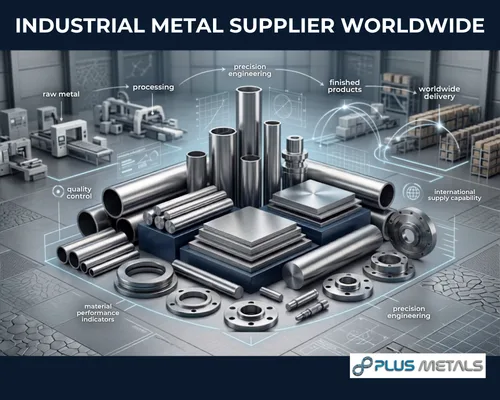
Invar 36 is a special nickel-iron alloy known for its extremely low thermal expansion. This means it changes very little in size when the temperature around it rises or falls. Because of this useful property, Invar 36 is widely used in industries where accuracy, stability, and reliable performance are important.
The alloy contains about 36% nickel, with iron making up most of the remaining composition. Its low expansion rate makes it different from common stainless steels and many other metals. It is often selected for precision parts, instruments, aerospace components, electronics, and other applications where even a small change in size can affect performance.
For companies looking for reliable metal and alloy solutions, understanding the properties and uses of Invar 36 can help in selecting the right material for a specific project.
Plus Metals, a leading specialty metal supplier, provides Invar 36 and other low thermal expansion alloys to customers worldwide with global supply and stock availability.
Key Properties of Invar 36
The most important feature of Invar 36 is its very low coefficient of thermal expansion. When exposed to changes in temperature, the alloy expands or contracts much less than many standard metals. This makes it suitable for components that need to maintain their shape and dimensions under changing temperature conditions.
Some key properties of Invar 36 include:
- Very low thermal expansion
- Good dimensional stability
- High strength and durability
- Good resistance to temperature changes
- Easy to machine with suitable methods
- Good welding characteristics
- Reliable performance in precision applications
- Useful mechanical properties at normal temperatures
Invar 36 is usually supplied in different forms, depending on the requirements of the application. These may include sheets, plates, bars, and other specially manufactured forms.
Why Is Invar 36 Used in Precision Applications?
In many industries, even a small dimensional change can cause major problems. For example, instruments used for measurement must remain accurate even when the surrounding temperature changes. If the material expands too much, the accuracy of the instrument can be affected.
Invar 36 helps reduce this problem because of its low thermal expansion. It is therefore used in precision measuring equipment, optical systems, scientific instruments, and other products where dimensional accuracy is important.
The alloy is also useful in electronic and aerospace applications. Some components may experience changes in temperature during operation, transportation, or exposure to different environments. Invar 36 can help maintain dimensional stability in these situations.
Applications of Invar 36
Invar 36 has applications across several industries because of its unique thermal properties.
1. Aerospace Industry
The aerospace industry often needs materials that can perform reliably under changing temperatures. Invar 36 is used for certain aerospace components, tooling, and structures where low thermal expansion is important.
2. Electronics and Electrical Applications
Invar 36 can be used in electronic components and systems where materials need to maintain stable dimensions. Its controlled expansion makes it useful for selected electronic packaging and precision components.
3. Precision Instruments
Measurement tools and scientific equipment require high dimensional stability. Invar 36 is used in precision instruments where maintaining accurate dimensions is essential.
4. Optical Equipment
Optical systems need precise alignment to work correctly. Temperature-related movement can affect the performance of sensitive equipment. Invar 36 is therefore used in selected optical and scientific applications.
5. Tooling and Manufacturing
Invar 36 is also used for tooling and manufacturing applications where low thermal expansion can help maintain accuracy during production processes.
Benefits of Invar 36
The main benefit of Invar 36 is its ability to maintain dimensional stability across temperature changes. This can improve the accuracy and reliability of products and components.
Other benefits include:
- Excellent dimensional stability: It helps components retain their size and shape when temperatures change.
- Reliable performance: The alloy is suitable for demanding precision applications where consistent performance matters.
- Good strength: Invar 36 provides useful mechanical strength for a wide range of engineering applications.
- Wide industrial use: It can be used in aerospace, electronics, scientific equipment, optical systems, and manufacturing.
- Reduced thermal movement: Its low expansion rate makes it useful when temperature-related movement must be kept to a minimum.
Invar 36 vs Other Metal Alloys
When selecting a material, engineers consider several factors, including temperature, strength, corrosion resistance, fabrication requirements, and cost. Invar 36 is mainly chosen when low thermal expansion is the priority.
It is important to note that Invar 36 is not selected for every environment. For applications that require high corrosion resistance, especially in seawater or marine conditions, engineers may consider other alloys such as Monel or stainless steel.
The choice between Monel vs Stainless Steel depends on the operating environment and project requirements. Monel for marine applications is often considered when excellent resistance to seawater and marine corrosion is needed. On the other hand, stainless steel for marine applications can be a practical choice for many marine components because of its strength, availability, and corrosion resistance.
When comparing Monel vs Stainless Steel corrosion resistance, Monel alloys generally offer excellent resistance in seawater and certain aggressive marine environments. However, the performance of stainless steel depends greatly on the grade selected. Marine-grade stainless steels, such as 316 and duplex grades, can provide strong corrosion resistance in many marine applications.
Therefore, choosing the Best Metal for Marine Applications requires a careful review of seawater exposure, temperature, chloride levels, mechanical loads, and the expected service life.
Choosing the Right Alloy for Your Project
Every industrial project has different material requirements. While Invar 36 is an excellent choice for applications that need very low thermal expansion, other alloys may be more suitable for corrosion resistance, high strength, or high-temperature service.
Before placing an order, it is important to check the required alloy grade, dimensions, specifications, testing requirements, and quantity. Working with an experienced metal and alloy supplier can make the material selection and sourcing process easier.
Get a Quotation Now & Build the Relationship
Looking for Invar 36 and other specialty metals and alloys for your industrial requirements? Plus Metals supports customers with global supply solutions and material availability based on project requirements.
Whether you need Invar 36 or are comparing materials such as Monel and stainless steel for demanding applications, our team can help you identify suitable material options for your needs.
Get a quotation now and build a long-term relationship with Plus Metals.
Contact Plus Metals
Global Supply & Available in Stock
Phone: +91 91673 47029
Email: plusmetals85@gmail.com
Address:
Shop No. 2, Ground Floor,
Jai SiddhiVinayak CHS Ltd (Durgadas),
Plot Nos. 13/13 A, Ardeshir Dadi “X” Lane,
C. P. Tank, Mumbai, Maharashtra 400004, India.
Frequently Asked Questions
Q1: What is Invar 36?
Invar 36 is a nickel-iron alloy containing around 36% nickel. It is best known for its very low thermal expansion, which allows it to maintain stable dimensions when temperatures change.
Q2: What are the main applications of Invar 36?
Invar 36 is used in aerospace, electronics, precision instruments, optical equipment, scientific devices, and specialized tooling where dimensional stability is important.
Q3: Why does Invar 36 have low thermal expansion?
The combination of nickel and iron in its composition gives Invar 36 its unique low-expansion characteristics. This allows the alloy to experience very little dimensional change over certain temperature ranges.
Q4: Is Invar 36 suitable for marine applications?
Invar 36 is mainly selected for its low thermal expansion rather than its marine corrosion resistance. For seawater and marine environments, alloys such as Monel or suitable marine-grade stainless steel may be considered depending on the application.
Q5: How can I choose between Invar 36, Monel, and stainless steel?
The best material depends on the application. Invar 36 is preferred for low thermal expansion and dimensional stability, while Monel and certain stainless steel grades may be better suited to applications where corrosion resistance is the main requirement. Engineers should consider temperature, environment, strength, corrosion exposure, and service conditions before making a final selection.