

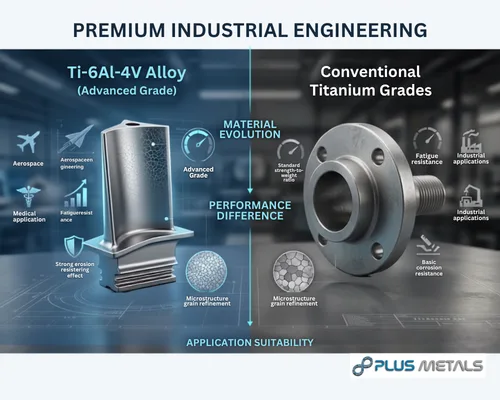
When engineers compare titanium options, the most common decision is between Titanium Ti-6Al-4V Alloy and conventional titanium grades such as commercially pure titanium. Plus Metals supplies specialty metals and alloys from Mumbai, India, with a focus on high-performance materials including titanium alloys for demanding industrial applications. Understanding the right grade helps buyers balance strength, corrosion resistance, formability, weldability, and cost.
What Makes Ti-6Al-4V Different
Ti-6Al-4V, also known as Grade 5 titanium, is an alpha-beta titanium alloy and one of the most widely used titanium grades in the world. Its popularity comes from a combination of low density, high strength, corrosion resistance, and heat treatability. These characteristics make it a preferred choice for aerospace components, marine hardware, medical devices, and high-performance engineering parts.
By contrast, conventional titanium grades such as Grade 2 are commercially pure titanium and are selected when corrosion resistance, good formability, and ease of fabrication matter more than maximum strength. This creates a clear Titanium Grade Comparison: Grade 5 delivers much higher structural performance, while Grade 2 is easier to shape and often more practical for chemical and marine equipment.
Ti-6Al-4V Alloy Properties
The main Ti-6Al-4V Alloy Properties that define its engineering value include high tensile strength, excellent strength-to-weight ratio, good corrosion resistance, and heat-treatable behavior. Typical published data shows density around 4.42 to 4.47 g/cm³ and tensile strength around 895 MPa minimum, with yield strength around 828 MPa minimum in Grade 5 material. It is also used at elevated temperatures in many service environments, with some references placing practical use up to about 400°C to 427°C depending on condition and application.
The alloy is not as easy to form as commercially pure titanium, but it rewards designers with much better structural capability. That is why it is common in load-bearing parts, rotating hardware, and parts that must survive stress, vibration, and fatigue.
Ti-6Al-4V vs Titanium Grade 2
The comparison of Ti-6Al-4V vs Titanium Grade 2 is usually straightforward once the service conditions are known. Grade 5 is the better choice for high-stress applications because it offers far greater strength and fatigue resistance. Grade 2, on the other hand, is the preferred option when excellent corrosion resistance, weldability, and easier forming are more important than strength.
In practical terms, Grade 5 is often used where failure is not an option, such as aircraft structural components, fasteners, and implants. Grade 2 is commonly used in chemical processing, desalination, heat exchangers, and marine service where fabricability and corrosion performance are key. For buyers, the right answer is not "which titanium is best," but "which grade is best for the job."
Applications by Industry
The main advantage of Titanium Ti-6Al-4V Alloy is its versatility across advanced industries. In aerospace, it is used for compressor blades, discs, rings, and structural components because it combines strength and low weight. In medical applications, it is widely used for implants and surgical-grade parts due to its biocompatibility and performance under stress.
Conventional titanium grades continue to dominate in corrosive processing environments. Grade 2 is widely favored in seawater exposure, chemical plants, and systems where fabrication simplicity reduces production cost and lead time. For procurement teams, this means the correct choice depends on whether the part must carry load, resist chemicals, or both.
Selection Guide for Buyers
Choosing between titanium grades should start with four questions: load, environment, fabrication, and budget. If the component must handle high stress or fatigue, Ti-6Al-4V is usually the stronger candidate. If the priority is excellent corrosion resistance with easy fabrication, Grade 2 often makes more sense.
Plus Metals supports buyers who need mill-certified specialty metals and custom processing, including cutting and distribution from stock when available. That makes it easier to source the correct titanium form for engineering, manufacturing, and maintenance projects.
Contact Plus Metals for Titanium Ti-6Al-4V Alloy
For Titanium Ti-6Al-4V Alloy and other high-performance titanium grades requirements, partner with Plus Metals—the trusted source for high-performance materials:
Email: sales@plusmetals.in
Call / WhatsApp: +91 91673 47029
Website: www.plusmetals.in
Message them today to discuss your requirements. They understand international standards and project timelines, delivering trust, quality, and long-term performance.
Frequently Asked Questions (FAQs)
Q1: What is Titanium Ti-6Al-4V Alloy?
Titanium Ti-6Al-4V Alloy is a high-strength alpha-beta titanium alloy, also known as Grade 5 titanium, widely used for aerospace, medical, and industrial applications.
Q2: Is Ti-6Al-4V stronger than Titanium Grade 2?
Yes, Ti-6Al-4V has much higher tensile and yield strength than Grade 2, which makes it better for structural parts.
Q3: Which grade has better corrosion resistance?
Both resist corrosion well, but Grade 2 is often preferred for highly corrosive chemical and marine environments because it is commercially pure and easier to fabricate.
Q4: Where is Ti-6Al-4V commonly used?
Ti-6Al-4V is commonly used in aircraft parts, fasteners, medical implants, marine hardware, and high-performance equipment.
Q5: How do I choose between Ti-6Al-4V and Grade 2?
Choose Ti-6Al-4V for strength, fatigue resistance, and load-bearing parts; choose Grade 2 for easier forming and corrosion-focused applications.