

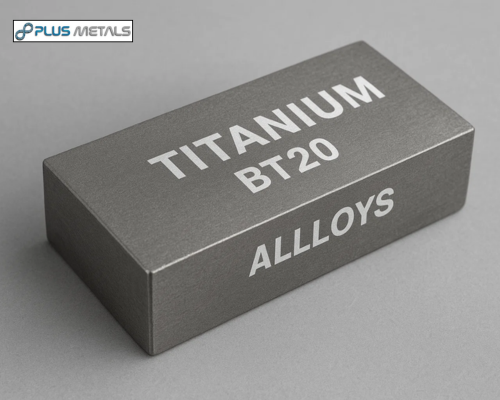
TITANIUM BT20 Alloy is a Russian-origin pseudo-alpha (near-alpha) titanium alloy, also known by the GOST designation VT20. It was developed for parts that must combine high strength with service in continuously elevated temperatures — up to about 500 °C — while still benefiting from titanium's passive oxide film and near-total immunity to chloride stress-corrosion cracking.
That combination makes BT20 a genuine problem-solver wherever chlorides, seawater, wet chlorine, or sour service are involved. It is not a nickel alloy, and it should not be selected for the strong reducing acids where nickel-molybdenum alloys such as C-276 are the correct choice.
What Is TITANIUM BT20 Alloy?
Per GOST 19807-91, BT20 is a titanium base alloy alloyed with aluminium (5.5–7 %), zirconium (1.5–2.5 %), vanadium (0.8–2.5 %) and molybdenum (0.5–2 %), with titanium as balance (85.15–91.4 %). Interstitials are deliberately held low — carbon below 0.1 %, oxygen below 0.15 %, nitrogen below 0.05 % and hydrogen below 0.015 % — because these elements are what drive hydrogen embrittlement and loss of ductility in titanium.
Aluminium and zirconium stabilise the alpha phase, while vanadium and molybdenum contribute beta-phase stability and strength. The high aluminium and zirconium content is what allows BT20 to hold its mechanical properties at temperatures where Ti-6Al-4V would already have softened considerably.
Because corrosion behaviour in titanium is governed by the surface oxide film rather than the bulk alloy, BT20 inherits titanium's passive performance — excellent in chlorides and oxidising media, and resistant to pitting, crevice corrosion and intergranular attack — without the nickel base and without its density penalty.
Properties of TITANIUM BT20 Alloy
1. High Tensile Strength at Low Weight
Annealed BT20 typically offers tensile strength of 880–1130 MPa depending on product form and size, with elongation of roughly 5–12 %. Against a density of only 4.45 g/cm³ — about half that of a nickel-base superalloy — this gives an exceptional strength-to-weight ratio for pressure and structural equipment.
2. Usable to 500 °C
BT20 is specified for components in continuous service up to approximately 500 °C, a clear advantage over Ti-6Al-4V for hot hardware. Its elastic modulus is about 112 GPa, and its low thermal conductivity (roughly 9–14 W/m·K across 300–500 °C) makes it a good thermal barrier.
3. Immune to Chloride Stress-Corrosion Cracking
This is the headline advantage over stainless steel and many nickel alloys. Chloride stress-corrosion cracking is effectively eliminated in titanium alloys, which is why BT20 is specified for chlorinated brine, seawater and sour hydrocarbon environments where austenitic stainless would crack.
4. Good Weldability
GOST data rate BT20 weldability with no practical restriction. Keeping interstitials low limits hydrogen pickup during welding, so proper gas shielding and cleaning remain essential.
5. Elevated Hardness in Converting
Rolled BT20 falls in a Brinell range of about 255–341 HBW depending on reduction and condition, which needs to be factored in when specifying machining allowance and tooling wear.
Corrosion Resistance of TITANIUM BT20 Alloy
Titanium resists corrosion because it forms a thin, stable, self-healing titanium dioxide film on exposure to air or moisture. BT20's performance follows this oxide film, so its chemical resistance is characteristic of titanium as a class.
Environments where BT20 performs very well:
- Seawater, brackish water and natural water
- Chloride brines and chlorinated process water
- Wet chlorine, chlorine dioxide and hypochlorite
- Nitric and chromic acid (oxidising media)
- Most organic acid process streams
- Sour hydrocarbon and H₂S-containing oilfield service
Limits worth knowing before you specify it:
- Not suitable for hydrofluoric acid, which attacks the oxide film directly
- Poor to fair in hot, concentrated reducing acids such as HCl and H₂SO₄ — use a nickel-molybdenum or nickel-chromium alloy there instead
- Attacked by dry hydrogen and by fluorine at elevated temperature; hydrogen embrittlement is the governing failure mode above ~500 °C
- Galvanic coupling to more noble metals must be avoided, as this can accelerate attack on the titanium
Note the direction of travel: titanium is strong in oxidising media and comparatively weak in reducing ones — the exact opposite of a C-276-class nickel-molybdenum alloy.
Industrial Uses of TITANIUM BT20 Alloy
1. Chemical & Chlor-alkali Equipment
Reactors, piping, valves, pumps and heat exchangers handling wet chlorine, brine and chlorinated water.
2. Aerospace & Turbine Components
Parts requiring higher hot-temperature capability than Ti-6Al-4V, including turbine and compressor hardware, fasteners and springs.
3. Oil & Gas / Sour Service
Downhole and subsea components in H₂S-containing service, where the immunity to chloride and sour stress-corrosion cracking is decisive.
4. Marine & Oceanographic
Seawater-exposed piping, heat exchangers and housings that also see elevated temperature.
5. Electrolytic & Pollution Control
Electrolysis cells, anodes, scrubbers and ductwork in aggressive oxidising service.
6. Medical & Biomedical
Implant and instrument applications benefiting from titanium's biocompatibility and inertness.
Why Choose Plus Metals for TITANIUM BT20 Alloy?
Plus Metals is one of India’s most trusted suppliers of high-quality TITANIUM BT20 Alloy, delivering certified materials to engineering, chemical, petrochemical, and industrial plants across the country. With years of experience and strong inventory management, Plus Metals ensures fast availability and world-class service.
What We Supply in TITANIUM BT20 Alloy?
Plus Metals offers TITANIUM BT20 in:
- Sheets & Plates
- Bars & Rods
- Pipes & Tubes
- Coils & Strips
- Fittings & Flanges
- Custom-cut sizes as per requirement
All products are sourced from global-standard mills and provided with testing certifications.
Why Industries Trust Plus Metals
✔ 100% Authentic Certified Material
✔ High-Grade Alloys with Mill Test Reports
✔ Ready-Stock Availability in Multiple Sizes & Forms
✔ Competitive Pricing for Bulk & Project Orders
✔ Fast Delivery Across India
✔ Expert Support for Material Selection
When your application demands high strength at elevated temperature combined with reliable resistance to chlorides, seawater or sour service, TITANIUM BT20 Alloy from Plus Metals ensures durability, safety, and long-term stability.
Buy TITANIUM BT20 Alloy From Plus Metals – Order Now
If you are searching for a trusted supplier for TITANIUM BT20 Alloy, Plus Metals offers high-quality material at the best market price. Whether you need sheets, plates, rods, or custom-cut components, Plus Metals is ready to serve your requirements.
Enquire Now
Visit: https://www.plusmetals.in
Buy Now – High-Quality TITANIUM BT20 Alloy Available in Stock
FAQs
1. Where is TITANIUM BT20 Alloy used?
BT20 (VT20) is used in aerospace, chemical and chlor-alkali processing, oil & gas (sour service), marine, and heat-exchanger applications where strength at 400–500 °C and resistance to chlorides are required.
2. Is TITANIUM BT20 corrosion-resistant?
Yes. It offers outstanding resistance to seawater, brines, chlorides, wet chlorine and most oxidising media. It is not a material of choice for concentrated hot reducing acids (e.g. HCl, H₂SO₄) — those are best served by nickel-molybdenum alloys.
3. Does Plus Metals supply TITANIUM BT20 Alloy?
Plus Metals supplies certified TITANIUM BT20 in sheets, plates, bars, rods, coils, pipes, tubes, fittings, flanges and custom-cut sizes as per requirement.
4. What are the advantages of buying from Plus Metals?
100% authentic certified material with Mill Test Reports, ready stock in multiple forms and sizes, competitive pricing for bulk/project orders, fast delivery across India, and expert technical support for material selection.