

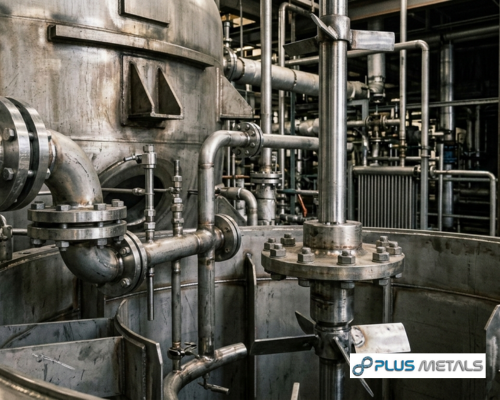
Chemical plants operate in some of the harshest and most corrosive environments in industrial manufacturing. Constant exposure to acids, chlorides, high temperatures, and aggressive process media creates ongoing challenges for plant owners who must ensure long‑term reliability and safety of equipment. In such demanding conditions, choosing the right material is critical not just for performance, but also for reducing unplanned downtime and maintenance costs.
As a premium metals & alloys supplier in India, Plus Metals understands the importance of durable, corrosion‑resistant materials for chemical processing equipment. One material that has proven its worth across the globe is Hastelloy — a family of nickel‑based superalloys known for exceptional corrosion resistance and mechanical stability under severe conditions.
Why Hastelloy Matters in Chemical Plants
Chemical processing environments often involve high pressures, high temperatures, and aggressive chemicals such as sulfuric acid, hydrochloric acid, and organic solvents. Traditional materials like carbon steel, stainless steel, or even some duplex alloys are prone to pitting, stress corrosion cracking, and rapid degradation in these environments.
This is where Hastelloy corrosion resistance in chemical plants becomes a game‑changer. Hastelloy alloys contain high levels of nickel, molybdenum, and chromium, which work together to create a protective barrier against corrosive attack. This composition drastically slows down metal deterioration, making these alloys ideal for long‑lasting equipment.
Enhanced Durability with Hastelloy Equipment
Durability is the cornerstone of efficient and safe chemical plant operation. When engineers design reactors, heat exchangers, piping, valves, and tanks using Hastelloy, alloy equipment durability becomes significantly improved because:
- High corrosion resistance minimizes thinning and structural loss over time
- Superior mechanical strength withstands high pressures and thermal cycling
- Resistance to localized corrosion, such as pitting and crevice corrosion, extends service life
Using Hastelloy reduces the frequency of equipment replacement and maintenance shutdowns. This not only increases productivity but also improves safety and lowers overall lifecycle costs.
Hastelloy C‑276: A Trusted Choice for Chemical Processing
Among the Hastelloy family, Hastelloy C‑276 chemical processing applications are among the most widely documented. C‑276 is a versatile, nickel‑molybdenum‑chromium alloy renowned for resisting corrosion in reducing, oxidizing, and mixed environments.
Plant designers and engineers prefer Hastelloy C‑276 for components like:
- Reactors and mixers handling strong acids or organic chemicals
- Heat exchangers where temperature gradients can accelerate corrosion
- Storage tanks and vessels exposed to acidic or chlorinated solutions
- Piping systems transporting corrosive process fluids
- Valves and fittings in critical process control applications
The balanced chemistry of C‑276 allows it to maintain integrity even when process conditions change unexpectedly, making it a reliable choice for many chemical processing applications.
Longevity for Reactors and Heat Exchangers
Integrating Hastelloy into critical equipment dramatically improves long‑term performance. Due to its outstanding corrosion resistance and mechanical properties, Hastelloy reactors and heat exchangers longevity outperforms many other materials under identical conditions.
For heat exchangers, which are often plagued by pitting and stress corrosion cracking due to temperature fluctuations and chlorine exposure, Hastelloy offers superior performance. Its ability to handle thermal stress without cracking or scaling ensures consistent heat transfer efficiency over years of service.
Similarly, reactors built with Hastelloy alloys endure aggressive reaction media and high‑pressure environments with minimal degradation. This means chemical plants can operate longer between maintenance cycles, reducing production disruptions and replacing critical equipment less frequently.
Why Choose Plus Metals as Your Hastelloy Supplier?
As a leading premium metals & alloys supplier in India, Plus Metals sources and supplies a comprehensive range of high‑quality Hastelloy grades, including C‑276 and other nickel‑based superalloys. We ensure:
- Certified quality materials compliant with ASTM, ASME and other global standards
- Customized solutions to meet your specific process and design needs
- Timely delivery supported by international logistics expertise
- Expert technical support to help you choose the right alloy for corrosion‑resistant performance
Our experience serving international buyers ensures that you receive not only premium materials but also unmatched service that supports your project from procurement to installation.
Ready to Improve Your Equipment Durability?
Ready to improve your equipment durability with high‑performance Hastelloy alloys? Contact Plus Metals – Your Trusted Premium Metals & Alloys Supplier in India.
Get expert assistance in selecting the right Hastelloy grade for your chemical plant and boost your plant's uptime, safety, and productivity.
Email: sales@plusmetals.in
Phone: +91 91673 47029
Visit: Plus Metals
Partner with Plus Metals for reliable, high-performance Hastelloy solutions that enhance your chemical processing investments and ensure operational excellence in the world's most demanding chemical environments.
Frequently Asked Questions (FAQ)
Q1: What makes Hastelloy superior to stainless steel in chemical plants?
Hastelloy contains higher amounts of nickel and molybdenum, which offer significantly better corrosion resistance, especially in chloride or sulfuric acid environments where stainless steels fail.
Q2: Can Hastelloy be welded without losing corrosion resistance?
Yes, Hastelloy alloys are designed for good weldability, and when properly welded and post‑treated, they retain their excellent corrosion resistance.
Q3: Is Hastelloy C‑276 suitable for high‑temperature applications?
Yes. Hastelloy C‑276 performs well at elevated temperatures and maintains strength and corrosion resistance, making it suitable for high‑temperature heat exchangers and reactors.
Q4: What industries benefit most from Hastelloy?
Chemical processing, petrochemical, pharmaceutical, pulp & paper, and offshore oil & gas industries benefit significantly due to their corrosive process environments.