

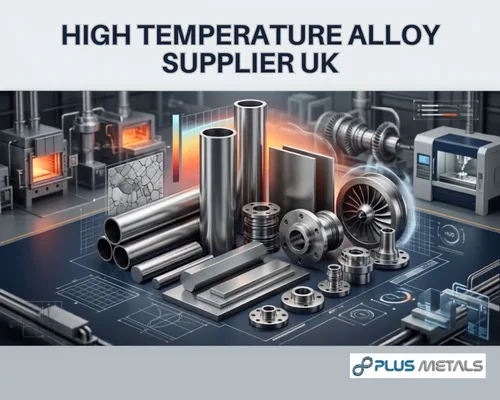
Industrial furnaces work under some of the most demanding conditions in manufacturing. They are exposed to very high heat, repeated heating and cooling, gases, chemicals, and long operating hours. Because of this, choosing the right material for furnace parts is very important. The wrong alloy can lead to early damage, cracks, oxidation, or costly production stops.
When selecting High Temperature Alloys for Industrial Furnaces, engineers need to look at more than just the maximum temperature of the furnace. The working environment, type of gas, load, heating cycle, and expected service life also play an important role. A good material should maintain its strength and shape while offering good resistance to heat, oxidation, and corrosion.
Plus Metals, a leading supplier of high temperature metal alloys, supports customers worldwide with global supply and stock availability for demanding industrial applications.
Why Is Alloy Selection Important for Industrial Furnaces?
Industrial furnace components may include heating elements, furnace trays, baskets, radiant tubes, support structures, retorts, rollers, and other parts. These components must continue working safely even when exposed to extreme temperatures.
At high temperatures, ordinary steel may lose strength and become weak or deformed. Some materials may also react with oxygen or other gases inside the furnace. This can cause scaling and surface damage over time.
For this reason, Furnace Materials for Extreme Temperatures are usually selected from special stainless steels, nickel alloys, and other heat-resistant materials. These alloys are designed to perform better in high-temperature environments and can help reduce maintenance and replacement costs.
Step 1: Know the Operating Temperature
The first step in any High Temperature Alloy Selection Guide is to understand the actual operating temperature.
A furnace may have a maximum temperature, but the material may not be exposed to that temperature continuously. It is important to know:
- Normal operating temperature
- Maximum temperature
- Continuous or short-term exposure
- Heating and cooling cycles
- Temperature changes during production
Some alloys perform well at moderate high temperatures, while others are better suited for extreme heat. Choosing an alloy based only on the furnace's maximum temperature may not always provide the best result.
Step 2: Consider Oxidation and Corrosion
High heat is only one part of the problem. The atmosphere inside the furnace can also affect material performance.
Furnaces may contain air, oxygen, hydrogen, nitrogen, carbon, sulfur, or other gases. These conditions can cause oxidation, carburization, nitridation, or corrosion.
This is why Heat Resistant Alloys for Industrial Furnaces should be selected according to the actual furnace atmosphere. An alloy that performs well in an air-based furnace may not be the right choice for a furnace with a reducing or carburizing atmosphere.
Understanding the chemical environment helps engineers choose a material with the right resistance.
Step 3: Check Strength at High Temperature
As temperature increases, many metals lose their mechanical strength. Furnace parts that carry heavy loads need an alloy that can maintain its strength during long periods of heating.
For applications involving high mechanical stress, creep resistance is also important. Creep is the slow change in shape that can happen when a material remains under load at high temperature for a long time.
The Best Alloys for High Temperature Applications are often those that offer a good balance of high-temperature strength, creep resistance, oxidation resistance, and long service life.
Step 4: Look at Thermal Cycling
Industrial furnaces are not always operated at one steady temperature. Many processes involve repeated heating and cooling. This can create thermal stress in furnace components.
If an alloy cannot handle repeated temperature changes, it may develop cracks or become damaged over time. Therefore, the heating cycle should always be considered when choosing a material.
For furnace parts that experience frequent temperature changes, selecting an alloy with suitable thermal stability and resistance to thermal fatigue can improve performance.
Step 5: Select the Right Alloy Family
Different alloy families offer different advantages. Stainless steels can be suitable for many high-temperature applications, especially where good oxidation resistance and cost balance are important.
Nickel-based high-temperature alloys are often chosen for more demanding conditions where excellent strength and resistance to heat and corrosion are required. The exact grade should depend on the operating temperature and furnace environment.
Common material choices may include heat-resistant stainless steel grades and nickel alloys such as Inconel, Hastelloy, and other specialized high-temperature alloys. However, the best choice should always be based on the actual application rather than simply selecting the most expensive alloy.
Step 6: Consider Service Life and Total Cost
The cheapest material is not always the most economical option. A low-cost alloy may need frequent replacement if it cannot handle the furnace conditions.
A better approach is to consider the total cost over the complete service life. A higher-quality alloy may have a higher initial cost but can provide longer service, fewer shutdowns, and lower maintenance needs.
When comparing High Temperature Alloys for Industrial Furnaces, consider both the purchase price and the expected performance over time.
Step 7: Work With an Experienced Metal Supplier
Choosing the right alloy can be difficult when several grades appear suitable. Working with an experienced metal and alloy supplier can make the selection process easier.
A reliable supplier can help you compare available grades based on temperature, furnace atmosphere, mechanical load, corrosion conditions, and application requirements. Availability is also important when urgent replacement materials are needed.
At Plus Metals, we support customers looking for quality metals and alloys for demanding industrial applications. With global supply and materials available in stock, we help businesses source suitable materials for their specific requirements.
Get a Quotation Now & Build the Relationship
Choosing the right material is an important step toward improving furnace performance and reducing unexpected maintenance. Whether you need heat-resistant stainless steel or nickel-based alloys, the correct grade depends on your operating conditions.
Get a quotation now and build a long-term relationship with Plus Metals. Share your required alloy grade, size, quantity, and application details with our team. We can help you explore suitable material options based on your requirements.
Contact Plus Metals
Plus Metals
Global Supply & Available in Stock
Phone: +91 91673 47029
Email: plusmetals85@gmail.com
Address:
Shop No. 2, Ground Floor,
Jai SiddhiVinayak CHS Ltd (Durgadas),
Plot Nos. 13/13 A, Ardeshir Dadi “X” Lane,
C. P. Tank, Mumbai, Maharashtra 400004, India.
Get a quotation now and build a strong, long-term relationship with Plus Metals for your metal and alloy requirements.
Frequently Asked Questions
Q1: What are high-temperature alloys used for in industrial furnaces?
High-temperature alloys are used for furnace components such as trays, baskets, radiant tubes, rollers, heating supports, retorts, and other parts exposed to high heat. They are selected for their ability to maintain performance under demanding temperature and environmental conditions.
Q2: Which alloys are best for high-temperature furnace applications?
The best alloy depends on the temperature, furnace atmosphere, mechanical load, and operating cycle. Heat-resistant stainless steels and nickel-based alloys are commonly considered for demanding furnace applications.
Q3: How do I choose the right furnace material?
Start by checking the operating temperature, maximum temperature, furnace atmosphere, corrosion risks, mechanical load, and heating and cooling cycles. These factors help determine the most suitable alloy grade.
Q4: Are nickel alloys suitable for industrial furnaces?
Yes. Many nickel-based alloys offer excellent performance in high-temperature environments and can provide good resistance to oxidation, corrosion, and loss of strength. The correct grade should be selected based on the specific furnace conditions.
Q5: Can Plus Metals supply high-temperature alloys globally?
Yes. Plus Metals provides global supply and has materials available in stock, subject to grade, size, and quantity requirements. Contact the team to discuss your material needs and request a quotation.