

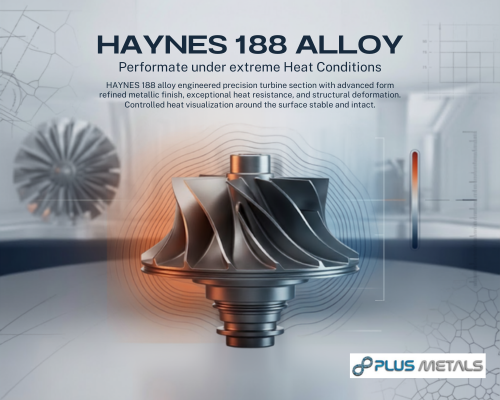
In the world of high-performance engineering, materials must withstand extraordinary challenges. HAYNES 188 Alloy stands as a pinnacle of heat-resistant metallurgy, offering exceptional performance under extreme thermal conditions. This cobalt-nickel-chromium-tungsten superalloy has become indispensable for aerospace, gas turbine, and industrial applications where temperatures exceed 1000°C. Plus Metals, a leading global supplier of specialty metals and alloys based in Mumbai, India, delivers this premium material with full mill traceability for demanding applications worldwide.
Understanding HAYNES 188 Alloy Properties
Chemical Composition and Structure
HAYNES 188 Alloy (UNS R30188, AMS 5608) features a unique composition that delivers outstanding performance:
| Element | Percentage Range |
|---|---|
| Cobalt (Co) | 39% minimum |
| Chromium (Cr) | 20.0–24.0% |
| Nickel (Ni) | 20.0–24.0% |
| Tungsten (W) | 13.0–16.0% |
| Carbon (C) | 0.05–0.15% |
| Lanthanum (La) | 0.03–0.12% |
| Iron (Fe) | 3.0% maximum |
The strategically added lanthanum creates a highly protective oxide scale, significantly enhancing oxidation resistance.
Key Mechanical Properties
HAYNES 188 alloy properties include:
- Tensile Strength: 192 ksi (1324 MPa) at 0% cold work, rising to 314 ksi (2165 MPa) at 50% cold work
- Yield Strength: 136 ksi (938 MPa) at 0% cold work
- Density: Approximately 8.6 g/cm³, providing excellent strength-to-weight ratio
- Elongation: 34% at 0% cold work, maintaining good ductility
- Melting Point: Approximately 1425°C (2597°F)
HAYNES 188 High Temperature Performance
Exceptional Thermal Resistance
The HAYNES 188 high temperature performance is exceptional, with oxidation resistance extending to 2100°F (1150°C) for prolonged exposures. This HAYNES 188 heat resistant alloy maintains structural integrity and mechanical strength at temperatures where conventional alloys fail.
Key performance characteristics include:
- Oxidation Resistance: Excellent protection up to 2000°F (1095°C)
- Creep Strength: Superior resistance to deformation under stress at elevated temperatures
- Sulfidation Resistance: Outstanding protection against sulfate deposit hot corrosion
- Metallurgical Stability: Maintains microstructure stability during prolonged high-temperature exposure
The alloy's high chromium content combined with lanthanum creates a protective oxide layer that prevents further degradation, making it ideal for combustion environments.
HAYNES 188 Alloy Applications
Aerospace Industry
HAYNES 188 alloy applications are most prominent in aerospace, where the alloy's properties meet extreme demands:
- Combustion cans and combustors: Primary application in gas turbine engines
- Flame holders: Critical for maintaining combustion stability
- Afterburner liners: Handles extreme thermal cycling
- Transition ducts: Manages hot gas flow between turbine sections
- Turbine blades: High-temperature strength prevents deformation
- Exhaust systems: Resists thermal fatigue and oxidation
Gas Turbine Engines
Both military and commercial gas turbine engines extensively use HAYNES 188 for combustion components due to its combination of fabricability, weldability, and performance. The alloy's ability to endure temperatures above 1000°C for extended periods makes it ideal for modern high-efficiency turbine designs.
Industrial Applications
Beyond aerospace, HAYNES 188 alloy applications extend to:
- Industrial furnaces: Heating elements and furnace components
- Chemical processing equipment: Corrosion-resistant components
- Power generation: Hot section components in power turbines
- Spray bars: Specialized industrial heating applications
Fabrication and Processing
Forming and Working
HAYNES 188 has good forming characteristics and can be forged, hot worked, or cold worked. However, it work-hardens rapidly, requiring frequent intermediate annealing for complex forming operations.
Welding
The alloy is well-suited for welding using TIG, MIG, electron beam, and resistance welding methods. Proper welding techniques ensure maintaining the alloy's high-temperature properties.
Heat Treatment
For optimal properties, HAYNES 188 should be solution heat-treated at 2150°F (±25°F) / 1177°C (±14°C) with rapid air cooling or water quenching.
Machining
Machining requires carbide or cobalt tools with adequate cooling. Diamond or CBN wheels are recommended for grinding to achieve precise tolerances.
Why Choose Plus Metals for HAYNES 188 Alloy
Plus Metals has built over two decades of reputation excellence in specialty metals and alloys. As an ISO 9001:2015 certified company, Plus Metals supplies HAYNES 188 alloy in various forms including sheets, plates, round bars, strips, coils, tubes, and wires with full mill traceability.
Key advantages:
- Four facility locations ensuring reliable supply
- Precision cutting, deburring, and distribution services
- Mill certifications included with all shipments
- 24-hour dispatch for stock items
- Competitive pricing with exact specifications
- Global supply chain support for Fortune 500 companies and individual engineers
Explore our full range of high-performance alloy solutions for your extreme temperature application needs.
Contact Plus Metals for HAYNES 188 Supply
For premium HAYNES 188 Alloy supply, partner with Plus Metals—the trusted source for specialty metal solutions:
Email: sales@plusmetals.in
Call / WhatsApp: +91 91673 47029
Website: www.plusmetals.in
Inventory: Sheet, plate, round bar, strip, coil, tube, wire, and custom fabrications
Shipping: Within 24 hours of order confirmation for stock items
Quality: Mill-certified materials with competitive pricing
Message Plus Metals today to discuss your HAYNES 188 requirements. They understand international standards and project timelines, delivering trust, quality, and long-term performance.
Frequently Asked Questions (FAQ)
Q1: What is the maximum temperature HAYNES 188 Alloy can withstand?
HAYNES 188 Alloy maintains excellent oxidation resistance up to 2100°F (1150°C) for prolonged exposures, with reliable performance up to 2000°F (1095°C). This makes it one of the premier HAYNES 188 heat resistant alloy options for extreme temperature applications.
Q2: What are the key HAYNES 188 alloy properties that make it suitable for aerospace?
The critical HAYNES 188 alloy properties for aerospace include: excellent high-temperature strength (192–314 ksi tensile), oxidation resistance to 2000°F, superior creep resistance, good weldability, and metallurgical stability at elevated temperatures. These properties enable reliable performance in turbine engines and combustion systems.
Q3: How does HAYNES 188 high temperature performance compare to other superalloys?
HAYNES 188 high temperature performance exceeds many conventional superalloys due to its unique cobalt-nickel-chromium-tungsten composition with lanthanum addition. The lanthanum creates a protective oxide scale, providing superior oxidation resistance to 2100°F compared to many alternatives. Its combination of strength and ductility at temperatures above 1000°C is exceptional.
Q4: What are the primary HAYNES 188 alloy applications in gas turbine engines?
Major HAYNES 188 alloy applications in gas turbines include: combustion cans, transition ducts, flame holders, afterburner liners, spray bars, and turbine blades. These components require materials that can endure extreme thermal cycling, high pressures, and corrosive combustion environments while maintaining structural integrity.
Q5: Is HAYNES 188 a heat resistant alloy suitable for welding and fabrication?
Yes, HAYNES 188 heat resistant alloy is well-suited for welding using TIG, MIG, electron beam, and resistance welding methods. The alloy has good fabricability and can be forged, hot worked, and cold worked. However, it work-hardens rapidly, so intermediate annealing is recommended for complex forming operations. Proper heat treatment at 2150°F with rapid cooling ensures optimal properties.