

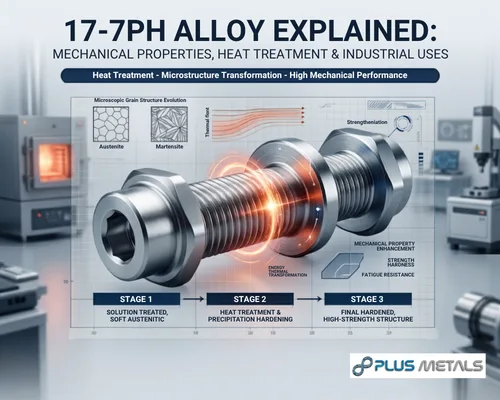
17-7PH (UNS S17700, sometimes referenced as 1.4568) is an austenitic, chromium-nickel stainless steel with aluminum additions that enable precipitation hardening. The alloy is supplied in a soft, formable condition and can be strengthened by controlled low-temperature aging treatments to achieve very high tensile strength while retaining reasonable ductility. Typical industrial forms include sheet, strip, bar, wire and forgings suited to aerospace and industrial components.
17-7PH Stainless Steel Properties
17-7PH stainless steel properties include a balance of corrosion resistance, high tensile strength, and fatigue life that distinguish the grade from conventional austenitic stainless steels. Typical tensile strength in peak precipitation-hardened conditions can reach into the range of ~1100 MPa (160,000 psi) with yield strengths and hardness varying by heat-treatment condition. The alloy also shows good formability in the annealed condition and minimal distortion during heat treatment, making it well suited for precision parts and tooling applications.
Mechanical Properties (Typical)
- Tensile strength: up to roughly 1100–1300 MPa in high-strength conditions, depending on specific temper and section size
- Yield strength: varies strongly with heat treatment; high temperature conditions deliver very high yield values suitable for load-bearing parts
- Elongation: reasonable ductility in many tempers (commonly 15–35% in annealed/soft conditions) enabling forming and fabrication prior to aging
- Fatigue resistance: excellent — a key advantage for cyclically loaded components such as springs and fasteners
These figures are indicative; final mechanical values depend on material form, percent cold work and the exact heat-treatment schedule used.
17-7PH Heat Treatment
Heat treatment for 17-7PH uses solution annealing followed by precipitation (aging) at relatively low temperatures to produce a range of tempers (for example CH900, RH950, TH1050 — industry shorthand for aging conditions). The process generally follows:
- Solution anneal (to dissolve precipitate-forming elements and produce a soft, ductile starting structure)
- Quench to retain the austenitic matrix
- Low-temperature aging (precipitation hardening) to form fine intermetallics that raise strength and hardness with minimal distortion
Aging temperature and time control final strength, toughness and corrosion resistance; lower aging temperatures often yield higher strength but can reduce ductility. Minimal distortion during heat treatment is a practical benefit for precision parts and thin-section components.
Industrial Uses and Applications
17-7PH stainless steel applications leverage the alloy’s strength, fatigue life and corrosion performance:
- Aerospace: springs, retaining rings, flat springs, torsion bars and structural parts that need high strength-to-weight with low distortion in treatment
- Fasteners and hardware: high-strength bolts, rivets and pins where repeated loading is expected
- Chemical and process equipment: components exposed to industrial atmospheres and mild corrosive media where higher strength is required
- Tooling and precision parts: gauges, molds and small tooling elements benefitting from formability then age-hardening
Because 17-7PH is unsuitable for highly reducing or marine chloride-rich environments without special precautions, selection must match the service medium. For a related precipitation hardening grade, see our guide on 17-4PH Alloy Applications Across Oil & Gas, Aerospace & Engineering Industries.
Design and Fabrication Guidance
- Forming: perform shaping operations in the annealed condition; the alloy work hardens and may require intermediate anneals for deep draws
- Machining: reasonable machinability in many tempers, but cutters and feeds should be selected to handle the alloy’s strength after aging
- Welding: welding is possible but requires controlled practice; localized soft zones near welds may need post-weld heat treatment to restore properties. Final mechanical values should be verified by testing after any welding or heavy cold work
- Surface finish and corrosion: while broadly corrosion resistant, prolonged exposure to aggressive chloride environments is not recommended without protective surface treatments or alternative alloys
Contact Plus Metals for 17-7PH Alloy
For 17-7PH Alloy and other precipitation hardening stainless steel requirements, partner with Plus Metals—the trusted source for high-performance materials:
Email: sales@plusmetals.in
Call / WhatsApp: +91 91673 47029
Website: www.plusmetals.in
Message them today to discuss your requirements. They understand international standards and project timelines, delivering trust, quality, and long-term performance.
Frequently Asked Questions (FAQs)
Q1: What is 17-7PH alloy used for?
17-7PH is used for aerospace springs, fasteners, torsion bars, and precision components requiring high strength, good fatigue life and low distortion.
Q2: How is 17-7PH heat treated?
Solution anneal, quench, then low-temperature aging (precipitation hardening) in specific tempers such as CH900, RH950, TH1050 to reach target strength and hardness.
Q3: What are the mechanical properties of 17-7PH?
High tensile strengths (often up to ~1100 MPa or more in peak tempers), good yield strength and excellent fatigue resistance; exact values depend on condition and processing.
Q4: Does 17-7PH resist corrosion?
It has good corrosion resistance in atmospheric and mild chemical environments but is not ideal for aggressive chloride or marine conditions without protection.
Q5: Can 17-7PH be formed and welded?
Yes — form in the annealed condition; welding is possible but may require post-weld treatment and verification to maintain properties.